
Connection first, inquiry-driven.

Before we ask more of a child, we get to know them
Most schools meet a child as a set of scores and place them accordingly. We do it the other way around; because a teacher who knows a child can tell the difference between “this is too hard” and “this is hard and she’s nearly through it.” One of those needs rescuing. The other needs ten more minutes alone.
A boy who’d been the difficult one at his last school spends a morning arguing, kindly and precisely, about whether a story’s ending was fair. His teacher doesn’t shush him. She takes notes.
The traits that made him too much elsewhere are the ones we came here to grow.
We start with their questions, not our answers
A teacher’s first job here isn’t to hand over the answer. It’s to protect the question long enough for a child to do something with it; because a kid who learns to wonder before they conclude is a kid who never stops learning.
A lesson on water starts with a third grader asking why the creek behind campus floods. By Friday, the class has built a model to find out. Nobody has opened a textbook.
A question in the fall can become an expedition by spring.


No ceiling, and no waiting
Children here move by stage, not by age. A first grader who’s ready for third-grade math does third-grade math, and nobody makes her wait for the calendar to catch up. The real ceiling most children hit isn’t the curriculum, though. It’s the teacher — the moment a kid asks something the adult in the room can’t follow. That’s the ceiling we hire against.
A fourth grader corrects his teacher on a point of astronomy. She checks. He’s right. The next morning there’s a harder problem on his desk, and no comment about it.
At Knox, your child never outgrows their teacher.

Some of our best classrooms have no walls
Santa Barbara is not the backdrop to a Knox education. It’s part of the curriculum. Alice Keck Park across the street, Alameda Park, the Museum of Art’s Ridley-Tree Learning Center hosting their fine art and ceramics program, walks to the Central Library, the shuttle to MOXI and the Sea Center, theatres within walking distance. Ideas stop being abstract the moment a child is standing in one.
The tide is out by ten. A question about what lives under the rocks takes the rest of the morning, and three of them are still talking about it at pickup.
By eighth grade, a Knox student has hiked Yosemite with a scientist and argued history on the steps in Washington.
What that looks like across a week
The philosophy is only worth as much as the work it produces. Here’s the substance underneath it.
Math
Placed by readiness, not by grade. Children work at the level they’re actually at, in small groups that shift as they move; which is why a class of ten might be working across four levels at once.
Science
Inquiry-led and hands-on. A question becomes a hypothesis, a build, a failure, and a second attempt. The lab is often outdoors.
Literature and writing
Real books, discussed the way adults discuss them. Children are expected to have opinions and defend them; and to change their minds when someone argues better.
Deep dives
Electives taught by people who do the thing for a living. Santa Barbara has an unusual density of scientists, artists, and writers, and a surprising number of them will teach a nine-year-old.
See what this looks like in your child’s grade
The approach is the same at every stage. What changes is what a child can do with it.

Kindergarten
Where Wonder Takes Root
The first year
Everything starts with a question, and at five, the questions are endless. Literacy and numbers grow out of play, curiosity, and being properly known from day one.
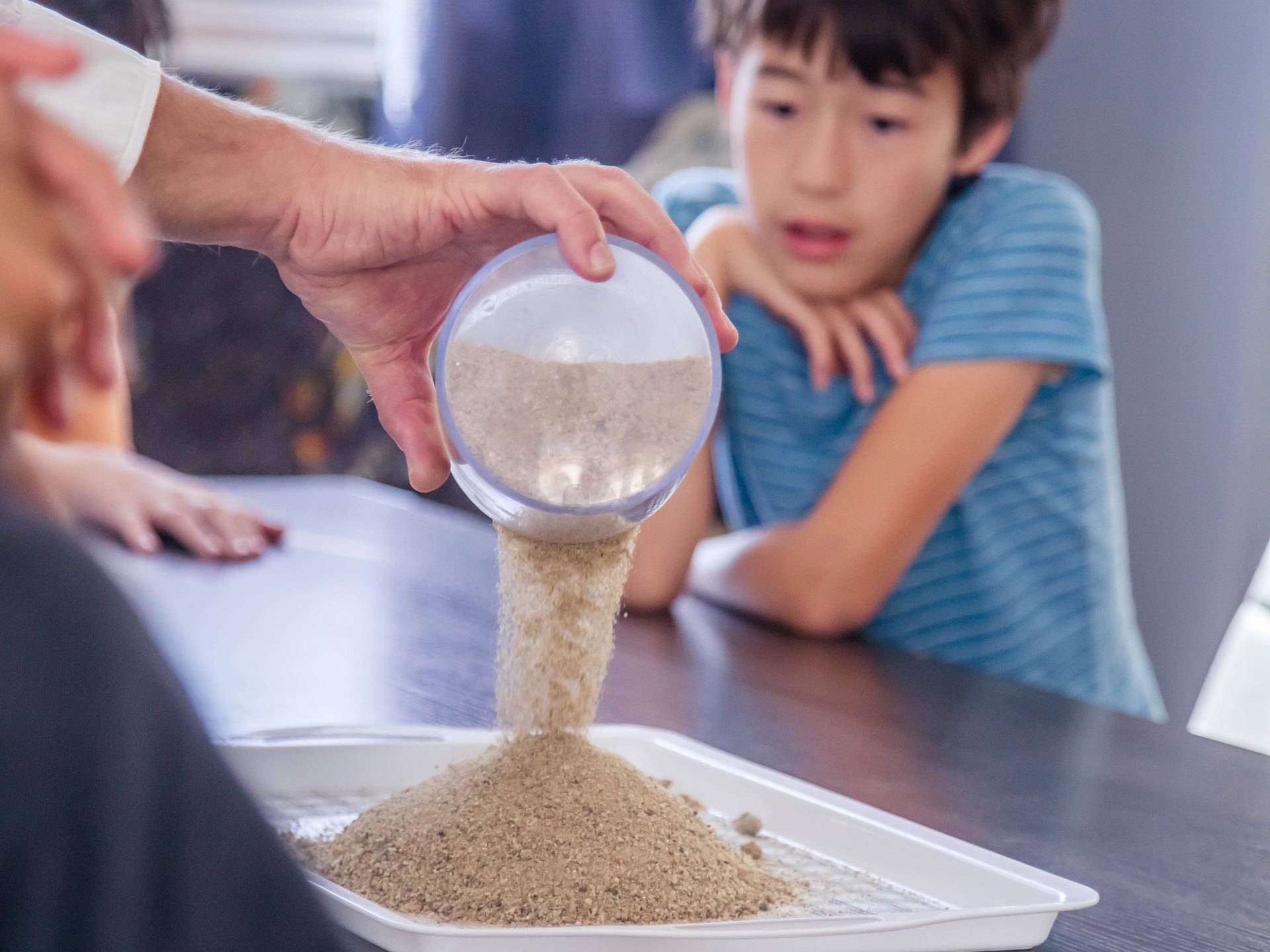
Lower School
Where curiosity finds its depth
Grades 1–4
A first grader who’s ready for third-grade math does third-grade math. Curiosity turns into projects, projects turn into work they’re proud of.

Upper School
Where Voice and Purpose Emerge
Grades 5–8
Deep dives with Santa Barbara experts, expeditions from Catalina to Yosemite, and a young person learning to defend an idea and bring people with them.

Stories from inside the school
A window into daily school life. What our students are working on, musings about the joys of teaching our learners, and exciting happenings within the school and community.
Unsubscribe at any time.